
PHASE 2: EXPLORE
- deepikagupta20
- Apr 12, 2021
- 6 min read
Updated: Apr 26, 2021
DETAILED STUDY
Phase 2 is all about studying our Subject in detail and exploring its various aspects. The brief was to plan and conduct a broad & detailed exploration of our selected subject of study, to initiate our design process.
Objective: To gain an insight into the selected subject of study - Explore & identify the design potential and scope - Get Inspired!
MAKING A PLAN:
The first step was to create a plan listing down 'what we know' and 'what we want to know' about our selected subject. We also have to think of research tools (primary and secondary) that we can use to further widen our research.

REFINED PLAN AFTER AFTER THE FEEDBACK:

DURING THE STUDY:
I started my research with first studying about the Form of the Neem tree. I was asked to make 50 Observational sketches and I was somehow able to complete them before my next presentation.
Here are some of my Observational sketches:
For detailed Form Study: Visit my google drive folder


For the detailed research work, I decided to dump my information on the google sheets so that I can organize it later.
Link to my google sheets: here
REVIEW OF w.i.p. of the Detailed study on 9th April:
The amount of information I collected was appreciated by my peers. The tutors however, asked me to now look at the form study more closely and try not just to draw the shape but also capture the geometry and proportions as well and identify the elements of design.
Also, I was asked to now explore the form in 3D as well but keeping in mind that the material should feel like the subject and the texture should be the same.
SURVEY ANALYSIS:
To further understand the social aspect, I decided to conduct a survey and understand how other people associate themselves with the Neem tree.

The first question asked about their geographical location so that it would help me understand the distribution of the Neem tree and also understand if the culture also influences one's perception about a Neem tree.

I realized that the Neem tree is widely distributed in various parts of India. However, the major concentration still lies in the western part (Rajasthan) because of it can thrive well in dry climatic conditions.
Among 40, 36 people have seen this tree and are able to identify it whereas 4 have only heard about it. So, I can say that Neem tree is widely known.

It is very common in around the neighborhood of various people.
Most of the people have even seen it in a park/ temple as well which is pretty common as the roots of the Neem tree are very large and thus it needs to be planted in an open space otherwise it may penetrate the walls of the house.
Such medicinal trees are very commonly found in villages as well due to their high usage by the rural people.
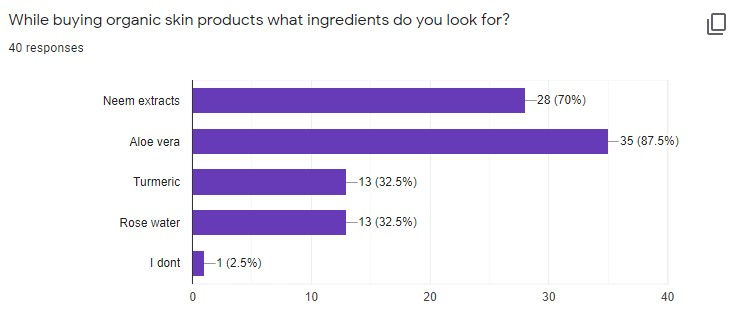
Today people are very concerned about their skin and they prefer organic products more. So, this question helped me understand whether they know about the medicinal properties of Neem and if they do, is it their priority?
I found out that while most people knew about its medicinal properties and preferred it, Aloe vera due to high availability in various cosmetics is the most preferred ingredient.
Had it been about the disease instead of the skin products, Neem might have been the most preferred ingredient.

When asked about a myth regarding the tree, most people mentioned its medicinal properties which makes me wonder that they are not aware about the scientific reasons behind those.
One myth that caught my eye was that "It was born from the drops of amrith" and after a little research I go to know that, "according to Indian mythology, amrita (ambrosia or the elixir of immortality) was being carried to heaven and a few drops of it fell on the Neem tree."
The person who wrote this myth belongs to Rajasthan which somehow proved my point that Neem has a significant role in our Indian culture, especially Rajasthan.


This is a table that I created to understand how people in different geographical areas see a Neem tree.
Almost everybody associated Neem as medicinal tree while 2 people thought of it as a natural habitat that needed to be preserved.
The only people who had a memory attached with it were the ones who grew up in Rajasthan with the tree in their home.


I further included two questions about the kind of person they are and what would they do if they could talk to trees for one day. I did so in order to understand how the personality of the person affects their association with the tree.
Almost everybody was grateful and wanted to thank the trees for the environment we live in.

Studies have shown that Beach people are lively and energetic. They are restless in their own way and want to uncover the truth behind various myths. The survey tells me that these people don't have a emotional connect with nature rather they are more motivated towards finding the truth behind the stories.
Mountain Person is someone who loves to be around nature and has a sensitivity towards them and they want to know the inner beauty of that.
Sky people are courageous yet calm and they try reason with everything they see around them. They like taking the initiative as mentioned in the survey that they would try to preserve the trees.
People who loves to explore forest are the share the deepest connection with the trees. They are able to sympathize wit them and are grateful. When asked the question, many answered that they would like to know how the trees feel about us which shows their sensitivity towards them. I PERSONALLY AM A FOREST PERSON
The people who like being indoor does not mean that they do not have any affection for nature. They are silent observers.
OVERALL OBSERVATION:
Despite not having a memory attached with the tree, people are sensitive towards nature.
This sensitivity is also triggered by the current scenario of climate change
Moreover, there is a difference between how rural and urban people associate themselves with the tree.
CRIT
PREPARATION FOR CRIT:
I decided to conclude all of my information into a single visual organizer. This was done so that I would be able to complete my presentation within the time limit.
List of References used: miro link
Link to miro: here

I even created a video to show my association with the tree visually.
FEEDBACK TO MYSELF:
I think that I need to work more on my form study and include material exploration as well
The one thing I liked about my presentation was the video in the end.
Also I think that I was so conscious about the time limit that I could not present my inferences and insights.
FEEDBACK GIVEN BY TUTORS:
More analytical drawings concluding with a one single visual analysis sheet
Exploring form study through material
Integrating my entire study into a single VO
How does Neem inspire me: (a) as an individual; (b) as a creative practitioner; (c) as a future interior-architect
After this I started working on my feedback.
More analytical form study: link
KEY FINDINGS: miro link

Revised my Key Findings as the previous ones were still facts

How does Neem Inspire me: miro link

CULMINATING PHASE 2
PERSONAL REFLECTION:
Phase 2 was a little tense at first as the depth and width of inquiry was much more than any other projects we have done. While I somehow managed to complete most of my tasks on the same day, I was not able to cover the width of the inquiry in some aspects like form study.
Besides, I realized that this time I was enjoying my research as I shared an internal connection with my subject and due to this I was able to show my association in a better way. There were a lot of times when I was able to make connection between my various categories and I wrote them down on my pin up board so that I don't forget them later. However, I still need time to improve my articulations and make out my own inferences and observations from the research that I conducted.
I was little conscious about the time as I was the first one to present during CRIT which somehow affected my presentation since I did not present my articulations well. This nervousness is something I need to eliminate and be confident about my work.
REVISED REFLECTION:
Phase 2 was a little tense at first as the depth and width of inquiry was much more than any other projects we have done. Even though I had covered good depth of the inquiry the width was yet to be explored. For this, I started exploring the form study in more detail capturing the proportions and using materials as well. Using materials in the second phase enabled me to manipulate them easily in Phase-3.
Earlier I first used to see other's presentation so that I can improve mine but being the first one to present during the CRIT made me understand that I should trust my decisions. After this I have started putting my name in the first column to present.
Besides all this, one thing I still need to improve upon are my articulations whether it is my key findings or reflection. This will help me get better insights and tackle the problems faced easily.


Comments