
PHASE 3: IDD-2
- deepikagupta20
- May 5, 2021
- 3 min read
Updated: May 22, 2021
BRIEF: Apply your 2D and 3D ideations developed so far, to a discipline specific context, to reach a creative design outcome that presents a thematic interpretation of your chosen subject that reflects your evolving personal creative expression.
EXPLORING CONTEXT
In this stage we have to select one design opportunity which has the potential outcome and also aligns with the context of our chosen disciplines. For this we can either list down its merits & de-merits or do SWAT analysis or can also use six thinking hats.

After listing the merits and de-merits, I realised that as an aspiring interior architect, creating a form & space would not only align to my discipline but also show my sensitivity towards my subject.
IDEATIONS
To see all of my Ideations, visit my miro board: link
FIRST ROUND OF ITERATIONS:
I first started my explorations by using different materials to know which one would work the best for my final outcome. However, it only got me more confused as none of them worked.


FEEDBACK:
The problem was in my approach. I was asked to first generate the form through sketches and then move onto material exploration.
SECOND ROUND OF ITERATIONS:
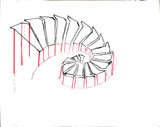
As asked earlier I drew 15 line drawings of various forms that could be generated from Neem leaf and shell.




FEEDBACK:
The ambiguity of the line drawings worked to my advantage as there could me 2-4 variations from each drawing. I was asked to select 6-7 ideas that I like the most and then create variations in them.
REALISATION:
This task made me understand the importance of form generation. Had I not drawn the forms first I would have kept failing in making the 3D outcome.
THIRD ROUND OF ITERATIONS:
In this I tried to visualize the line drawings as a 3D form by either making 3D drawings or using materials to visualize it.

FEEDBACK:
There was a voting that happened in the class and the last two ideas were selected. Now I had to choose between those two ideas by doing more form visualization exercise.
REALISATION:
I liked the last idea the most, maybe because I had made it using materials as well. But somehow I was still not able to visualise the second last idea (first green-red colored sketch in the last 2nd row).
FOURTH ROUND OF ITERATIONS:
In this I first took a paper cone and made half cuts in it in order to curve it. However, I was still struggling to get the curve right and make it self standing.


FEEDBACK:
The idea looked good. I was suggested to take up the challenge of making it self standing. For this I could also use supporters which would be aesthetically integrated in the form.
SELF-REALISATION:
I liked the idea and wanted to take it further so as to achieve a proper final outcome.
FIFTH ROUND OF ITERATONS:
I started using various materials such as paper cups or pipes to get the curve right.


FEEDBACK:
I still needed to look into the edge, width, ridges and joineries of the form.
SIXTH ROUND OF ITERATIONS:
This time I used thermocol to understand the curve and I was finally able to resolve the form.


FEEDBACK:
The tutors were happy that I was finally able to understand its curvature. However, the form looked like as if it had been carved out of a cuboid, so I was asked to further manipulate the form, play with its surface and width.
REALISATION:
Using thermocol to create the form made it easier for me to visualize it as thermocol has a certain thickness which adds to the three dimensionality of the form.
SEVENTH ROUND OF ITERATIONS:
I tried various techniques to manipulate the form

FEEDBACK:
The iterations were approved by the tutors. Now I was finally ready to start working on my final outcome. The only thing I had to keep in mind was to not make the form perpendicular to the ground and also the width should not be of the same size.
REALISATION:
It made me understand the importance of prototyping. Had I not kept making these mock ups I would have never been able to choose the best possibility.
REFLECTIVE NOTE
Unlike IDD-1 my IDD-2 was full of ideas. However, it still tested my patience when it came to form visualization. Generating the forms in the starting not only made me challenge the notion of the shell but also improved my form visualization skills. In this phase of iterations I was able to apply my learnings from think lab activities (challenging assumptions; and scale & context).
My greatest achievement of this phase was the form manipulations as it opened my mind to new possibilities. Had I not done those manipulations I would have never been able to get out of my comfort zone.
IDD-2 taught me many things and the importance of prototyping is a major learning as it actually helped me spot the mistakes and rectify them.


Comments