
GALAXY OF ART & DESIGN
- deepikagupta20
- Feb 19, 2021
- 15 min read
Updated: Mar 25, 2021
INTRODUCTION:
As the name suggests, this project revolves around Art & Design developed in different areas in different time periods. The main objective is to increase our awareness about historical, cultural and contemporary creative (art & design) practices, their influences and driving forces, and how they have evolved over the ages.
This is a four week long group project which combines the learning of modules Design Environment and Visual Skill, supported by Design Studio.
PHASE 1: EXPLORE
PRE-WORK:
LISTING MY FAVOURITE 'WORKS OF ART': I was a little confused at first when we were asked to list our favourite 'works of art' as I wasn't sure if it includes architectural buildings too. I knew through my MT and VS projects that it included paintings as well as sculptures but I also remembered reading famous historical buildings as a part of ART HISTORY, so I just went ahead with what I felt was right.
Google Slides link: here


WAYS OF SEEING: By John Berger
Ways of Seeing is a 1972 BBC four-part television series of 30-minute films created chiefly by writer John Berger and producer Mike Dibb. In this series, he criticizes traditional Western cultural aesthetics by raising questions about hidden ideologies in visual images.
EPISODE 1: watch here
In the first episode, John Berger questions the assumptions made about the traditions of European paintings. and in the hope of finding its answer, we would also discover something about ourselves and the situation we are living in.
Perspective centers everything on the eye of the beholder. It is like a beam from a lighthouse only in this case the appearances travel in.
The camera is the subject of debate here and there's a little satire about how it shows us the world the way it (camera) sees it and how it runs alongside a horse's mouth.
He debates how the reproduction of paintings with the invention of camera has multiplied its possible meanings and destroyed the original one.
How everyone associates different meanings to a particular painting according to their individual experiences.
He also tells that how through his programme we are receiving images and meanings which are arranged. While we should consider it we must also be skeptical of it.
EPISODE 2: watch here
I feel that this whole episode somehow objectified women as the first line is only about how "men dream of women and women dream of themselves being looked at".
Berger says that a woman continuously surveys herself and how her every glance is a judgement. He also says that how she appears to men is of crucial importance to her as if they are a sight to be looked at.
The one category in European oil paintings in which women were the recurring subject was the nude. It shows the criteria by which women were judged and seen by the others.
Kenneth Clark says that being naked is simply being without clothes but nude is a form of art. A nude has to been seen as an object in order to be a nude.
Further describing the topic, Berger takes the example of the story of Adam and Eve and tells us how nakedness is in the eye of the beholder. It also tells us how the women was blamed for the nakedness and was given children in sorrow and the husband in desire while the man becomes the agent of the God.
In the European tradition, the nude always implies an awareness of seen by the spectator that they are naked as we see them. For example, The Judgement of Paris
To be naked is to be without disguise- a disguise which cannot be discarded.
When shown these paintings to a group of women, they tagged them as immensely exaggerated and very unreal. They also said how men and women both are centers of narcissism but the women is only related to the other person which puts her in a much more passive position.
EPISODE 3: watch here
This episode is about the value of European oil painting and understanding from where does this value come from.
Objects in those paintings appear tangible but one also buys along with the painting the look it represents. Berger talks about how paintings show treasures but now have become one and how art galleries are now banks which needs to be guarded in night.
He also takes the example of two films which were made as a war propaganda to engender pride in their national culture heritage to show that the experience of art is sublime.
According to Berger, one cannot explain anything in history, especially art history by the love of art alone.
European oil painting placed a unique emphasis on the tangibility, solidity, the texture, the weight, the graspability of what was depicted. What was real was what you could put your hands on.
Many works of art in other periods have celebrated wealth and power/social or divine order and are static but the European paintings glorified not a static order of things, but the ability to buy and furnish and to own.
Portraits were painted to celebrate the continuity of power and worthiness. Every portrait is a record which says, "I once existed and looked like this". Berger also says that the way each picture is painted contradicts the essence of the story.
He ends the episode by saying that, "if we don't judge the culture of European oil painting leaving aside its claims for itself, we will find that oil painting was, before anything else, a medium that celebrated private possessions. But now it has been broken by publicity."
EPISODE 4: watch here
In this final episode of John Berger he analyse publicity as advertisement and compare them to the tradition oil paintings.
Berger also talks about how color photography has taken over the role of oil paint, though the context is reversed. The oil paintings used to show what we have and the way they were living but publicity shows what we aspire to have but have not achieved yet.
He examines the concepts of glamour, publicity and advertising today, and what these were back in the era of traditional paintings while comparing their original context, poses, actions etc.
He also focuses on how publicity does not allows us to accept us the way we are but make us dream about what is shown in the advertisement.
He also argues that people who have become enviable by the consumption. Being enviable makes the person glamorous and then publicity manufactures glamour and earn money .
At the end he looks up at the magazines to further explore the inconsistency between our culture and what existed before in oil paintings .
DAY 1: WARMING UP
We started the first day of the project with a warm-up activity working in a group of 8-10 students. The questions that we were asked to answer were:
Where do you think an artist draws his/her inspiration from?
How does an artist decides upon the medium, materials, tools & techniques to be used?
Why do we create art?
Who is an artist?
After an half an hour discussion among the group members, below is our presentation:
Link to miro: here

ZOOMED IN SHOTS:





REFLECTION:
As someone who calls herself an artist, I think that everybody who has a certain way of communicating/ expressing their ideas or feelings is an artist, all one needs to have is an inspiration. According to me, inspiration can come from anywhere, be it our surroundings or our emotions or even the simplest things.
But then again, the question comes, "why do we create art". I create art for self-satisfaction. It is my way to escape the reality for sometime. While most of the people do so as a medium of expression, others might do it for money too. Even I sometimes make paintings for people on commission.
But besides all those materials, techniques and purposes to create that artform, is an ARTIST.
MAIN INQUIRY:
Now after the warm up session, our minds were prepared to do the main task. In this the groups were allotted specific time period and area to start working on.
The brief was to study the various art expressions (2D & 3D) during that time and to understand the context in which it was made in order to get an insight about the people's lifestyle and their social, political and economic aspects.
The time period assigned to my group was 1800AD-1890AD INDIA.
STEP 1: PLAN
NORMS FOR GROUP WORKING:
We started our inquiry by first laying down certain norms that we as a part of the group should abide by.

KEY POINTS TO KEEP IN MIND:

WHO WILL DO WHAT:
We decided to divide the areas on the basis of the physiographical divisions of India instead of dividing it on the basis of directions (north, south, east and west) because the geographical conditions would be same in the whole area in one physiography.

PLAN OF ACTION:
Since we had to collect quite a large number of information so we decided to lay out a plan mentioning how we would proceed in order to simplify the information collection process and to avoid any confusion.

FIRST APPROACH:
We decided to keep the heads and sub-heads same for every one in the group as it would be helpful while drawing out conclusions. However, the first approach was rejected as it focused more on the history of the area rather than the artworks.

CHOSEN APPROACH:
We then decided to look for artworks and studied the previous heading by decoding the context of those artworks.

STEP 2: RESEARCH
After a discussion with our tutors we decided to maintain the same heads for each member to work on.
Link to Google Sheets: here
Link to Google Slides: here
Link to miro: here
SYNOPSIS OF MY STUDY:
My area of study included the central part of India (Madhya Pradesh, Chhattisgarh, Orissa, Maharashtra) during 1800 AD- 1890 AD. The main objective of this research is to look at the various artforms that were developed in that region and to understand and analyze the reasons behind their creation. Not only this, while doing so, also try to decode the context and understand the lifestyle of the people as well as their social and cultural aspects. This research gives an in-depth knowledge about the art and also provide an insight.
FRIDAY ACTIVITY: CONCLUSION OF PHASE 1
After three days of collecting information, we were now required to assimilate all the findings and make interconnections between them, decoding the context and understanding how was life during that period.
1. This flowchart is about the various connections that we as a group were able make out between different regions of India. We even listed down the context due to which these artworks were created.

ZOOMED IN SHOTS:





2. While doing our research we also found out that there were certain events that did not have an impact on the artforms or even if they did it was not direct.

3. With the invention of camera in the 19th century, there were certain pictures too that helps us understand the context of that time period.

4. Since most of the artforms were greatly affected due to colonialism, we also tried to show those areas on the map.

FEEDBACK RECEIVED FROM TUTORS:
The presentation went really well. It was really appreciated by the tutors. The only thing we were asked to do was to research more about the nature of Indian societies and look for insights.
After a little research about the various social groups in our individual area, we created a social hierarchy for each region.

Social hierarchy of my region (Central India):

KEY REALISATIONS:
The one thing that I realized was that religion was an important aspect and also a main trigger for various artforms.
The revolt of 1857 changed the socio-political scenario of the country not only in terms of segregation of living area (into Black and white towns) but also with the introduction of new laws to suppress future rebellions.
Major technological advancements such as camera and printing press also became a way to create awareness among the Indians.
The Indian society inhabiting various communities was closely knit and thus the concept of 'Divide and Rule' came into effect.
Various events such as the introduction of railways did not directly affect the artforms but somehow led to the development of architecture with the setting up railway colonies.
REFERENCE LIST:
Link to miro: here

DELIVERABLES OF PHASE 1:
This was divided into two parts:
A) ESSAY:
we are required to write a comprehensive essay (900-1000 words) about our research based on the trigger questions that we listed and were also given to us. Keep in mind to not repeat everything that is there in the google sheets.
Trigger questions:
From where the art works got information and what was thier inspiration?
Which communities were involved during formation of art schools ?
What are the different forms of art and are they connected in any way ?
What were the similarities between the different artworks of different regions ?
What were the major beliefs and norms of the people of different regions
why was British impact irregular in different areas ?
Does the lifestyle of people influence the art forms practices?
What were the impacts of colonialism and how did they vary from one region to another?
how colonial period changed art and design of that era ?
what does the changes in architecture communicate to you ?
what triggered need of new expressions during that time ?
What were the dominant ideologies prevalent during that time period?
How have the different art forms grown after colonial rule ?
how technological advancement changed the idea of art and display ?
what new mediums were introduced for communication ?
Pdf of the Essay:
B) VISUAL ORGANIZER:
In this task we were required to assimilate our findings about our specific area and create a handmade visual organizer showing interconnections and decoding the context. We could also use visuals and color coding to mark out specific areas.

(Click on the arrow to see the zoomed in shots)


PHASE 2: EXTEND
PRE-TASK:
We were required to select 5 forms of expression (painting/architecture/sculpture) each from the area assigned to us.
Link for the Google sheets: here

Title: PATTACHITRA PAINTING
Area: Orissa
Artist: Oriya painters
I selected this painting not only because it was aesthetically pleasing but because it was detailed. As a painter, adding details to a painting is one of my favourite things to do.

Title: WARLI ART
Artist: Warli Tribes
Area: Maharashtra
Warli art being one of the most famous tribal arts of India is itself a form of abstraction in the way it depicts humans. This is why I chose this as I have great appreciation for this art.

Title: BHIL ART
Artist: Bhil Tribes
Area: Chhattisgarh
This art resembles to that of aboriginal art in Australia and I had created these paintings before as well. So I was confident that it would be easier for me to make this.

Title: TOWN HALL
Artist: Colonel Thomas Cowper, Bombay Engineers
Area: Bombay
Year: 1833
Since we had to select one architecture too, I decided to go with this one as it looked easier to make than the other architectural buildings. (Link to image)

Title: VICTORIA TERMINUS RAILWAY STATION
Artist: F. W. Stevens
Area: Bombay
Year: 1888
This style (Indo-Sarcenic) is a blend of Hindu and Muslim architecture with European style. As someone who is fond of Indian history, I really liked this style.
FINAL PAINTING SELECTED:
VISUAL LANGUAGE:
In this task we would be working on the Visual analysis of the artwork through "Observe-Analyse-Recreate-Interpret".
STEP 1: OBSERVE & ANALYSE
Identifying the Elements of Design (EOD) in the painting and analyzing the principles of design (POD) in it.
Link to miro: here


STEP 2: INTERPRET
We had to interpret the theme behind the artwork and why did the artist choose to make this. Besides this, we also had to write down our own interpretation.

STEP 3: RE-CREATE
Based on our observations, we had to re-create the selected piece as an abstract visual composition.
Keep in mind: The outcome should resemble the arrangement of elements on the original piece and carry its visual essence.
1. Since my painting was very ornamental with the usage of various dots and lines in the details, I decided to re-create the ornamental part of it. This is why I decided to use white color on black and not the original colors to emphasize on the minute details. The medium used were acrylic colors.

(Process photos)


2. Even though I was happy with my first outcome, I tried another one. In this one I did not focus much on the borders or the background rather I tried to show the colorful essence of the artwork as well as create Emphasis on the central figures who are dominating the whole composition.
It did not turn out the way I thought as I used ceramic cones to add the details but they were not working properly.

FINAL OUTCOME:
Out of the two I decided to go with the first re-creation as my Final outcome because even though it was a black and white composition, it still had all the EOD and POD in it.
STEP 4: PRESENT
STEP 5: CONCLUDE
Pattachitra art is the folk art of Orissa. Though started from the 16th century along with the Bhakti movement, this art revived in the 18th and early 19th century. Due to the Bhakti movement, the major themes revolve around Lord Jagannath and his (Vishnu) ten incarnations.
If I talk about the Visual composition, the artform is highly ornamental by the use of various lines and dots to add details. The most significant feature is the huge round eyes creating a center of attention for the viewer. Besides this, the decorative borders not only gives uniformity to the painting but keeps the eye inside the canvas.
Talking about the balance, the whole painting has a vertical symmetrical balance. Not only this but even the curtains and the head gears have balance and show rhythm. The black background create emphasis on the orange colored figures. Like each artwork has its own story, this one tells me about the importance religion had in the lives of these people.
Looking at this painting I'm remined of the 'Shantha Rasa' which I did during Sense & Sensitivity as the whole painting despite being so detailed and ornamental is still peaceful and has its own calmness.
VISUAL & MATERIAL CULTURE:
This activity is about identifying the Visual culture (tangible and intangible expressions by people which communicate visual norms) and Material culture (aspect of social reality).
STEP 1:
For this we needed to select five works of art that belongs to same category of expression and time period (and place / civilisation) as the one we have been working on for Task on Visual Language.
Next step was to spot the similarities and differences among them. This would help us to understand the how a particular category of expression was interpreted by the people living there.

While the similarities were many, spotting the differences was a little difficult to me as during those times the major part of that area was dominated by one type of community and they were very closely knit which led to the identical thoughts and themes.
STEP 2:
This step required us to expand our area of research by not limiting ourselves onto one category of expressions but various categories (2D as well as 3D).
We were asked to collect a minimum of 25-30 images belonging to various categories of expressions and creating a Pinterest board.
I made this board on miro as I'm more comfortable working there. Also I even added the reference link for the images alongside them.

Now that we had identified various forms of expressions, it was time to spot the similarities and differences between each expression as well as among all the expressions.
This task would not only help us identify the major themes and inspirations of that time period but also tells us about the main purpose (which Deepak sir also told us how in context to Indian art, it is the purpose that keeps changing) as to why these expressions were created and understanding the socio-cultural context of the people of that area during that time.
Similarities and Differences between each expression:
(Click on the arrow to see the next one)


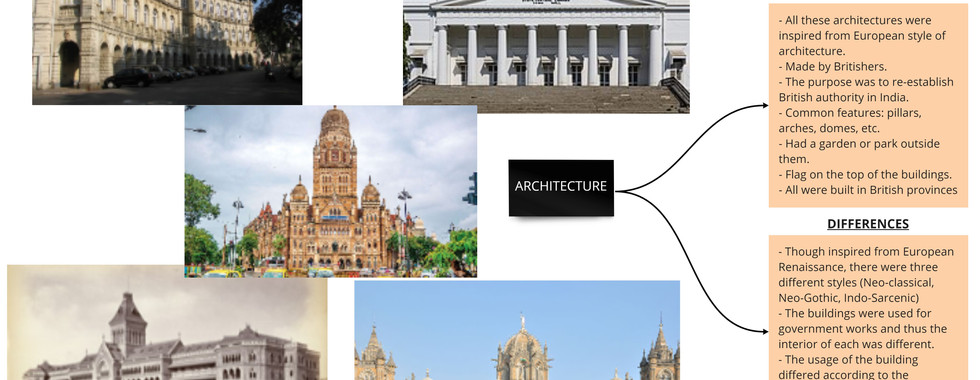


Similarities and Differences among all forms of expression:

Now the process of funneling down the information started. We had to select 10-15 artworks among the 25-30 selected in the previous step and list down the common keywords/ key phrases which define that form of expression.

Here is a presentation video for steps 1 &2:
STEP 3: REFLECTIVE NOTE
After observing and analyzing the similarities and differences among various forms of expressions I realized that for the people of my region, religion was an important aspect. But with the advent of British rule, there were few changes due to European influence that were visible, especially in the architecture. I remember Deepak Sir telling us how in context to Indian art it was the purpose that kept changing and in my region too there were different purposes. For the Britishers, it was a way to re-establish their authority while for Indians it was now a way to express their feelings and not just showing devotion to their gods.
There were many other factors which indirectly influenced the creative practices such as the introduction of camera enabled people to capture the essence of their daily lives. With the introduction of railways and setting up of factories, urbanisation happened creating a vast difference among the rural and urban lifestyles, way of clothing, interiors.
While there were a lot of common threads, I could also see a difference among the beliefs and values of different social groups. The tribes though living a primitive life, each tribal community identified different forms of God as their local deity. There was also a difference in the language as well as the clothing as it depended upon the climatic conditions of that region.
My understanding about the concept of Visual and Material culture:
Visual culture according to me is the use of visuals to express aspects of a culture. It includes the tangible forms of expression and communicates about the lifestyle, culture, or anything else through visual means. Material culture is basically the study of physical objects such as tools, weapons, building etc. which informs us about the human-made forms of expressions.
While visual culture is something that can be seen as 2D/3D, the material aspect talks about the 3D nature. What I think is that to understand the visual and material culture, is to understand the history of that time period.
Another thing that I found the most interesting was how by just understanding these cultures, one can get an insight into people's lives during those times. These both studied together helps one peel the layers of social reality and understand the imagery, symbolism or get deeper insights about the major themes, ideologies and thinking patterns of the people.
PHASE 3: REALISE
GROUP DISCUSSION 1:
We were required to share our awareness about the visual and material culture of the time period (and area) assigned to us (work done during Phase-2) among our groups and make a 5min presentation.


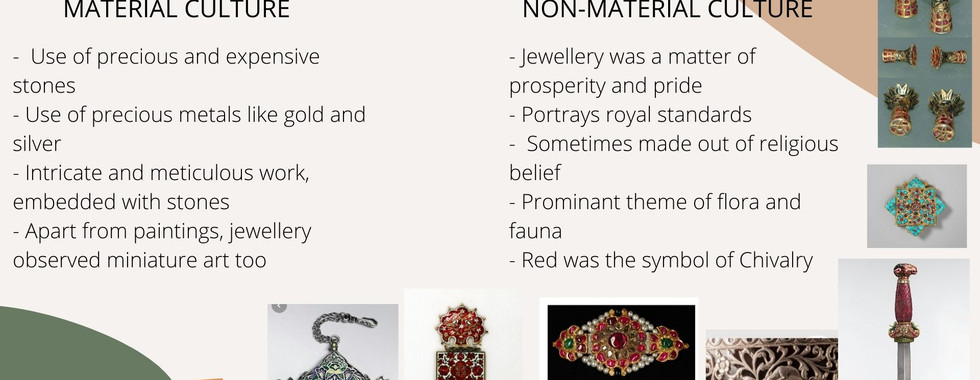


GROUP DISCUSSION 2:
This time the discussion was about the 'Meaning-Making' of a visual expression. We had to identify how does one create a meaning about a creative visual expression and what according to us our the factors that contribute towards its "Meaning Making"?


GROUP DISCUSSION 3:
Today's discussion was about the main topic on which the whole project was based that is 'Art & Design'. We had to answer the following questions:
How are Art and Design correlated?
How does an understanding of the history and evolution of Art help us as students of Design?

ZOOMED IN SHOTS:


FINAL GROUP PRESENTATION
Working collaboratively in a group we had to prepare a 7 minutes long video-podcast to provide an overview of the creative expressions in the time period assigned to our group. We also had to keep in mind that the content should cover the visual language, Visual and material culture and the major themes, ideologies and thinking patterns.
Behind The Scenes:
Here is the image of the map that my peers (Lavanya Jain, Prisha Goel and Sanskriti Majeshwari) created for the final presentation. Lavanya Chadha did the editing part whereas I created the digital map at the end of the video and helped my members translate their scripts into hindi.

My contribution to Group's work:
Link to google slide: here


Comments