
REALISATION
- deepikagupta20
- Jan 23, 2021
- 2 min read
Updated: Jan 24, 2021
INTRODUCTION:
After studying the various aspects of context of design through various tasks over the past two weeks, now was the time to articulate our realizations about the relationship between 'context and design'. Through the journey of the object, we have also studied the journey of making, the journey of user association and most importantly, 'THE JOURNEY OF MANKIND'
TASK 8: REALISATION I
This task was divided into three parts in which we had to funnel down the 'factors that influence the design of an object'.
PART: A
We were first required to create our own list of factors that influence the 'consumer and buying behaviour'. Then working in groups of 4-5 students, we had to collate all our factors into a common list.
Individual work:
Personal (convenience, reliability)
Economical (affordability)
Brand value
Psychological (their perception)
color and shape
Social (profession, age)
Safety
Group work:

PART B:
For this part we were asked to take a few steps back and recall our insights drawn from 'Form study', 'Ergonomics study', and 'Understanding making'; and create a consolidated list of factors as a section together.
Miro link: here

PART C:
Working individually, we had to create our own list of factors that influence the design of an object in an engaging visual poster.

REFERENCES:
Miro link: here

TASK 9: REALISATION II
This was a group task in which we had to present our learning on 'the relationship between context and design' in an informative, engaging and entertaining manner. However, we were refrained from using google slides or PPT.
So after a lot of discussion we decided to do it through a role play (showing how we understood it through discussion with our peers).
TASK 10: REALISATION III
PART 1:
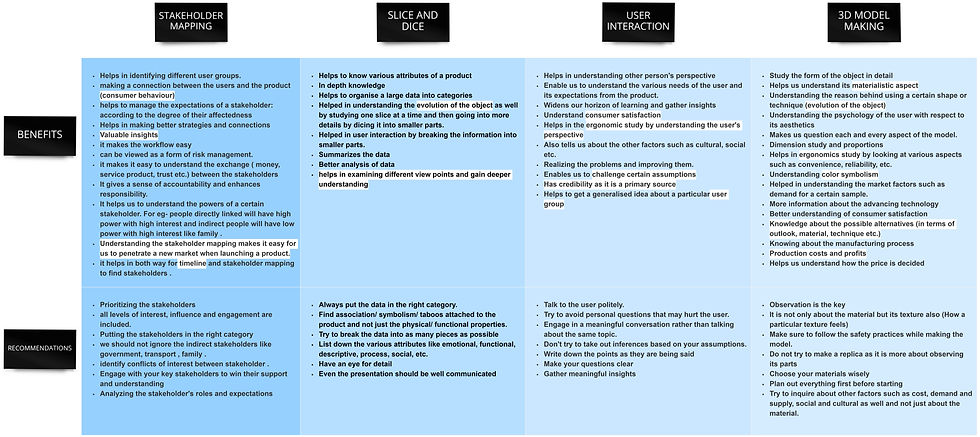
Working in groups we had to list down the benefits and recommendations of a particular activity that we did while inquiring about the object.
This task was not meant to share our understanding of the object which we gained from this particular activity but to reflect on its process and how it as a tool of information is helpful to us
Group Members: Prisha Goel and Lavanya Chadha


PART 2: REFLECTIVE WRITING
a) Listing down the benefits and recommendations for other activities:
Miro link: here
b) Primary and Secondary methods of inquiry:
Primary method of inquiry is collecting the data firsthand/ through self-conducted research.
For example, surveys and personal interviews. Whereas the secondary method of inquiry is collecting data through indirect sources/ published sources. In this, the researcher relies on the data collected by others, for example, newspapers and websites.
Primary methods are best suited when we have to understand a person's perspective. Since it is collected first hand, it is recommendable to use it while doing an extensive research about specific topics. On the other hand, Secondary methods are effective when the feedback is required quickly. Moreover, it may help the researcher find the exact answers.

Miro link: here


Comments