
GALAXY OF ART & DESIGN: Learner's Log
- deepikagupta20
- Mar 20, 2021
- 9 min read
Updated: Mar 22, 2021
ILLUSTRATED GLOSSARY:
1. Creativity: It is a process of imagination and expression of one's individual ideas.

2. Art: Art is a subjective term and is a medium of expressing one's own individuality.

3. Design: Design is a problem solving process done to fulfil a need or a purpose.

(Link)
4. Aesthetics: Something which is attractive and pleasing to the eyes.
5. Visual language: Use of visual elements such as EOD and POD that can be visually seen in the artwork to do further analysis.

6. Visual Culture: Visual culture is the use of visuals to express aspects of a culture which includes the tangible forms of expression and communicates about the lifestyle, culture, or anything else through visual means.

7. Material Culture: Material culture is basically the study of physical objects such as tools, weapons, building etc. which informs us about the human-made forms of expressions.

8. Non material culture: refers to the intangible aspect of culture which helps us to understand the beliefs, ideologies and the thinking patterns of the people.

9. Ideology: The basic ideas or beliefs of the people which forms the basis of their social and cultural context.

10. Meaning Making: The process of interpreting the situation and understanding the context
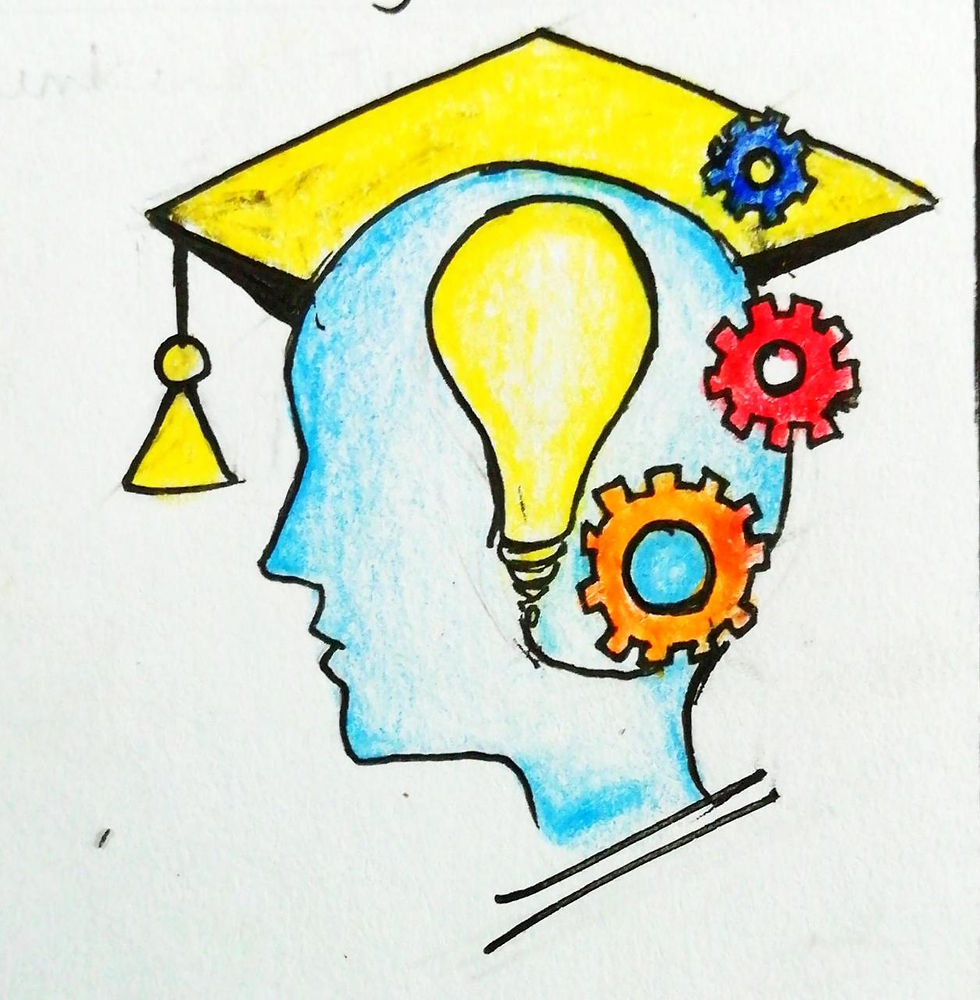
11. Thematic Communication: Identifying the major themes and through interpreting the reason behind the artwork and understanding its context.

12. Synopsis: a brief summary of the whole research giving a general view about the contents studied.

13. EOD: Elements of design such as lines, dots, form, color or texture
14. Zeitgeist: Zeitgeist meaning the spirit of age is one way of understanding the history of any region.

15. Re-create: a process of re-making the artwork in our own abstract style in order to understand the Elements and Principles of Design.

16. POD: Principles of design such as Balance, harmony, Emphasis

TALKS
During the whole phase-2, we also participated in a series of talks that helped us get a better learning experience as well as gave us an insight into our own research area based on those talks/presentations.
Below are my notes which I made during the talks:
TALK-1: Identity and Design & Identity in Design
By- Anisha Shekhar Mukherji
The talk started by discussing the the various forms that we associate with being Indian and their themes of flexibility and frugality, sustainability and efficiency and utility and decoration, and individuality and improvisation. So if these themes/ attributes seem to be Indian then the question comes are these exclusive to India? These themes are the defining attributes or 'lakshana' of Indian design (architecture being an important part). It also talked about if these attributes are the rules and not the exception how do we differentiate between the objects and building made India to those made outside India which might have these attributes too. One way to do so is through the expression of these attributes which is a cultural standpoint.
The use of word modern seems to be confusing sometimes contradictory and in design terms it seems to be generally limited to appearances and values seen as not traditional and therefore not Indian.
Making design context specific and apart from individual traits there is also a cultural influence and cultural context which is consciously and unconsciously reflected. To understand this, we need to look at the identity from inside.
These Lakshana of collective responsibility; self reliance; divergence/diversity is what sets the Indian identity. The design is not just about aesthetics but also about the ethics and value system which are unique to different cultures.
TALK-2: The two paths of architecture in the age of the modern
By- Prof. Snehanshu Mukherjee
This talked focused more about the architecture in the west than in the Indian context as Indian context is much more complicated. The talk started with an introduction about modernism and how it formed the backbone of Industrial Revolution. However, we also notices that even though the machine ae created startling inventions, it has also caused untold misery for the working class. Several artists such as John Ruskin and William Morris rejected the idea of mechanised production. They did not subscribe to modernism but chose a different approach.
Studying further, we also got to know about the Bauhaus style of architecture which was based purely on functional requirement unlike neo-classical. In contrast to this was Semper saying that "Architecture has to be monumental" and thus started a rebellion against the machines. We also talked about the Deco style of architecture, Mauvism, Expressionism and Impressionism.
Considering today's scenario, it is an era of post-truth and working with the context is very important.
MY OPINION:
What I think is that while Industrial Revolution has brought many significant changes, at the same time it has affected the climate. We are so much surrounded by modernism that despite everything we do to promote handmade crafts, we somehow rely back onto machines. Depiction of historical landscapes have always been an inspiration for various artist but now the artworks are mostly influenced by the loneliness and depression which the machine age has caused.
TALK-3: Style, Stylistic evolution and the notion of zeitgeist : The Indian perspective
By- Dr. Deepak Kannal
The talk focused on the notion of Zeitgeist (spirit of the age) as one way of understanding the history and in this case Indian History. We learned that the word 'style' comes from stylus and how style is affected by the region of Zeitgeist. It made us understand how evolution and evolutionary patterns can be helpful in tracing the historical development.
The Indian art tradition (especially the sculptures) is divided into three phases. While Winckelmann's theory focused on "the evolution in the pattern from rudimentary to ideal figures", it was not applicable to Indian context because a lot of artworks in India were coming from the outside. If we see from Mauryan Period to Gupta period, the one thing that has changed is the intent/purpose of creating these art.
Phase 1 of the Indian art can be seen in the early sculptures from Mathura (Mrichhkatika). It is depicted by very lively and natural depiction of figures. It was a time when Indian art had a celebration of daily life. Moving on to the next Phase 2, the sculptures became lifeless isolated by their surroundings. The Phase 3 brought back the liveliness and also added calmness to the figures. These phases known as SATYA-VANIKA-NAGAR together form the zeitgeist.
After the discussion, I was a little confused as sometimes the sculptures tell more than one story, so how should I interpret it? The answer I received from sir was very beautifully quoted that, " the ambiguity of the language is its limitation as well as its potential". It is for the viewer to see for themselves which story they relate to the most. And I think that in my case if I ever face a conflict like that I would go with the one which my heart believes.
TALK-4: Clothing: An Overview
By- Prof. Archana Shastri
The talk started with the knowing the etymology of the word clothing which comes from two words originating in the Rigveda, one being 'VASA' meaning cloth and the other 'NIVAS' meaning living. Hence, clothes are an essential part of one being. Then the talk moved onto explaining the two domains, material and non-material (tangible and intangible) of culture.
It also talked about how the body was the first primary canvas for clothing as it was vulnerable and needed to be protected and thus with it symbolism and notions of beauty got attached such as tattoos, writings on the skin. Most of the material culture included whatever man made, wore, and formed whereas the non-material culture included various norms, beliefs, practices, etc.
Garments were not static, they also evolved with technology becoming a symbol of individual identity. It was interesting to know how the motifs or the patterns also tells us about the kind of community (Hindu, Muslim, Marwari) which is naturally understood by the people co-inheriting together.
At the end of the talk the basis of whole notion of clothing was that, the man is in the center living in his environment and the world-view is communicated through the skills and the materials.
SENSE & SENSITIVITY:
My opinion on the internal process by which creative expressions result:

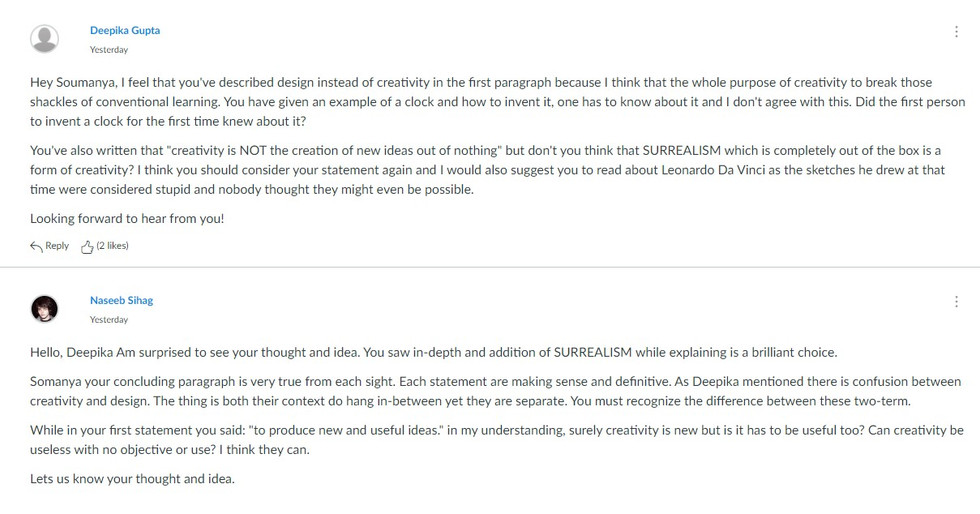
FEEDBACK RECIEVED:


FEEDBACK GIVEN:







PERSONAL VIEWS ON ART & DESIGN:
When I first started the project with a discussion about art, I was very excited as someone who loves to paint, art is an integral part of my being.
For me art is a way of expressing my feelings and it is done to express one's individuality. However, the three week long Journey made me realize that the purpose of creating art is different for each individual. For some it may be aesthetic pleasure while for others it can be to raise awareness about a particular topic. I personally create art to escape from the reality for a while.
Every art has its own story and it is left for the viewer to interpret its meaning which is influenced by their immediate surrounding, other opinions, their cultural beliefs and even the surrounding of the art work. The process of interpreting the meaning was beautifully quoted by Deepak Kannal Sir that "The ambiguity of language is a limitation but also a potential of it".
This whole process of inquiry and decoding the context got me thinking about the difference between art & design as there were certain similarities in the way they both drew inspiration. I have always thought that Art is for self-satisfaction and to express one's individuality while Design is done for other people to fulfil a need. After the various group discussions I realized that Design can sometimes be called art because of its aesthetics whereas art can never be design as it (design) requires to solve a problem.
These realizations helped me get better insights about the social and cultural context of my area of research and enabled me to understand the perspectives of other groups as well. After this three week long journey, I still don't want to draw a line between art & design even though my understanding of these concepts have become clearer as I believe that there is more to explore.
STRUGGLES & ACHIEVEMENTS:
During Process of Inquiry (Phase 1):
The major struggle was finding about the artists as the artworks during that time were patronised by the rulers. It was also a bit challenging at first while working on google sheets for me as I am used to working on miro.
This phase's greatest achievement was the connections that we as a group were able to make out between our areas of research. I also think that we not only able to identify the context but also decoded the various aspects such as Economical, Social, cultural, political, etc.
While Understanding the Visual Language (Phase 2): I knew what are the Elements of and Principles of Design but the abbreviations (EOD & POD) got me a little confused. However, identifying the elements was easy but understanding the reason/principle behind those elements was the difficult part for me. For example, in my painting, lines and dots had been used to depict details but the question was "Did these elements serve a principle too (Balance, eye movement)? or they were just made to depict the fine jewellery?"
My achievement for this phase would be interpreting the theme and message behind the artwork. After studying various rasas in Sense & Sensitivity, I was able to identify them during the Thematic communication.
While Understanding the Visual & Material culture (Phase 2 & 3):
The whole term Visual & Material Culture was new to me and it took me some time to understand what the topic exactly needed. While doing this task, the most difficult step was to list down the similarities and differences among all the categories of expressions because there were a lot of differences than similarities and I had to dig deeper to understand whether there were any similarities between the ideologies or the thinking patterns.
As much as I struggled to identify the visual and material culture individually during Phase 2, the term became more clearer when discussed within the Group during Phase 3. We all were able to come to a conclusion about it and I think that understanding this topic is one of my greatest achievements of this phase.
During Final Group Presentation:
Since our time period was 1800 AD- 1890 AD India, we wanted to give our audience a feel of how India was during that time. The inspiration came from the movie 'Panipat' to make a map and through it make our audience also travel to different parts of India. But the task wasn't as easy as we first thought of making the introduction part using digital medium only but then decided to do it manually as none of us were good enough at it.
But I did not want to give up and decided to use the digital medium for the conclusion part (filling of red color in the map) and I would like to thank Lovelish sir for making it possible. He not just once but twice arranged an extra session with our group and helped us execute the idea.
The editing was also not an easy part and it was only because of the spirit of all the other members of my group (Sanskriti, Prisha, Lavanya Jain, Lavanya Chadha) that we were able to figure out that part as well.
TEAM WORKING:
For the most part of the project we were required to work in groups and I think that working collaboratively in a group has both advantages and challenges.
ADVANTAGES:
Increases the team spirit
Better engagement and communication with the team members
Increases learning possibilities
Understanding different perspectives in order to gain better insights
Better creativity and increased thinking process
Inculcates leadership qualities
Reduces the amount of work and time consumed
Learning from others helps one evolve as a person
Makes us to be able to adapt to any situation in future
Gives you a chance to improve on your weaknesses
CHALLENGES:
Conflict between two points of view
Competitiveness among the members
Not listening to each other and blaming for failure
Finding a common time to work collaboratively
Low engagement in group
Suggestions for my own self to improve the efficiency of working in a group:
Always introduce yourself and your strengths
Listen to everybody's point of view
Try to solve the conflicts between the members
Celebrate the team's success together even if it is a small one
Have trust and make friends. This way it would be easier to express yourself.

Comments